Budget season is a time of optimism. You start believing that next year's launches, campaigns, and competitive pushes will happen in an organized way, with calendar invitations, complete requirements, and enough lead time for everyone to do their homework.
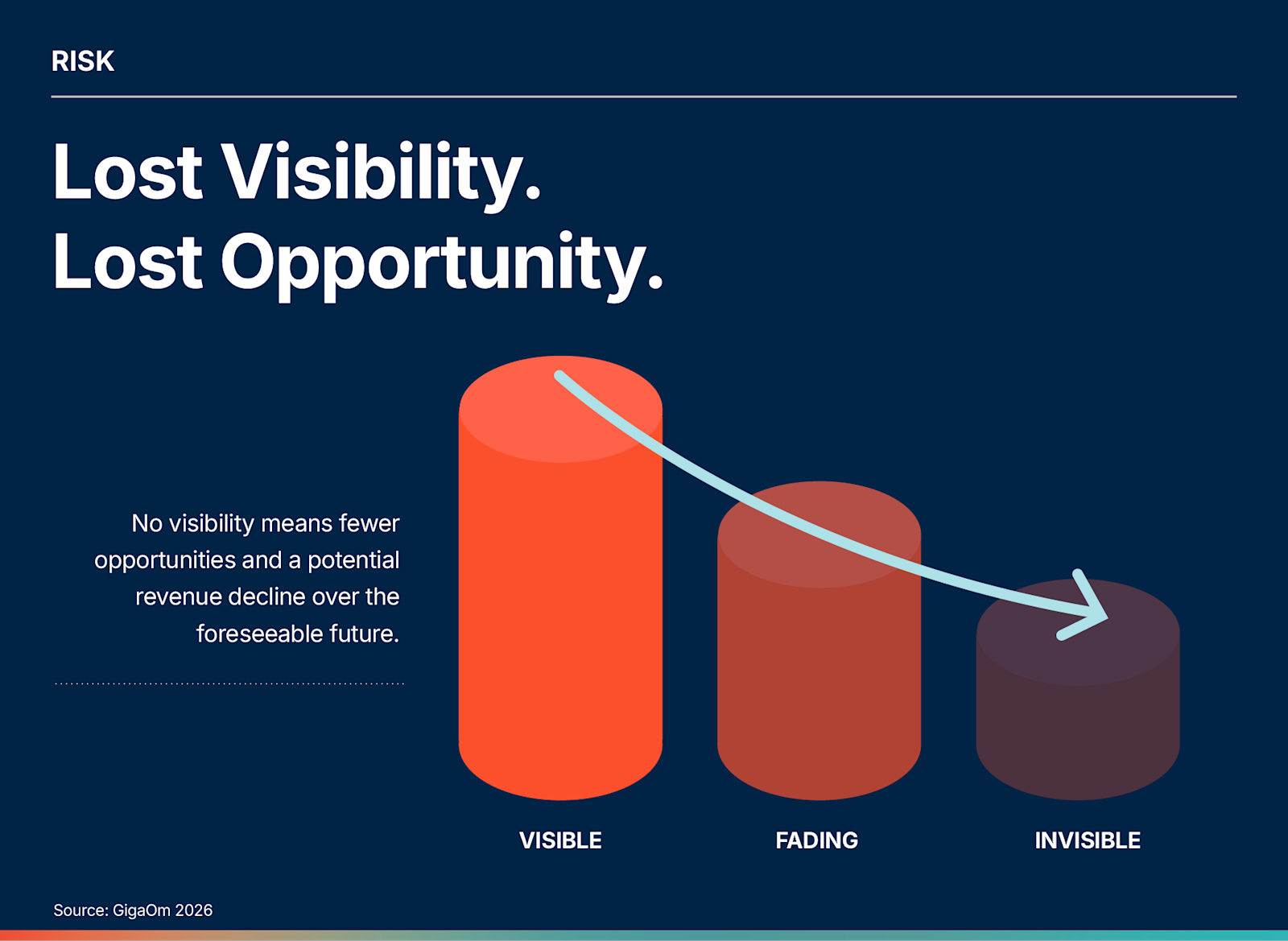
Of course, it doesn't usually happen that way. A competitor repositions. A big deal stalls because the buyer wants independent validation. Your CEO asks how you stack up in a category, and the board wants the answer by Friday. Meanwhile, a GigaOm Radar in your category is published, the budget to use it is already spoken for, and you lose the visibility opportunity it offers.
The GigaOm Radar closes that gap. It's an independent, vendor-neutral analysis of your market. When you plan for it, you can show buyers an outside view of your position before they form one without you.
Key Takeaways
The GigaOm Radar is an independent technology market report that scores vendors through three executive lenses: the CTO (innovation), the CIO (efficiency and total cost of ownership), and the CISO (risk and compliance).
Vendors that budget for Radar results ahead of time can include them in sales, marketing, and analyst-relations plans the day a report is published, instead of scrambling for mid-year approval.
The 2027 line item should cover more than the report itself. It should also cover the derivatives that put results in front of buyers, such as the CxO Brief Lite and Sales Enablement.
What is the GigaOm Radar?
The GigaOm Radar is an independent research report that evaluates technology vendors in a market from the perspective of the three executives who sign off on enterprise technology purchases: the CTO, the CIO, and the CISO. Every evaluation criterion maps to one of those three buyers. Results are shown on a single chart that places each vendor by quadrant, ring, and velocity.
This gives buyers a vendor-neutral comparison they can trust, rather than evaluating solutions solely on vendors' claims. For vendors, the takeaway is that the Radar doesn't stop at "leader or not." It gives you three executive-specific results, a quadrant story, and a momentum signal, and each of those is a separate message you can take to market.
Why Should Independent Research Be a Planned Budget Item?
Independent analysis gives teams a shared frame of reference. Buyers can compare solutions on consistent criteria instead of piecing together individual vendor claims. Investors get a starting point with an established view of the category, instead of rebuilding the landscape for every deal. And vendors can see where their offerings are positioned in the markets their customers are actually evaluating.
By including GigaOm research reports in your 2027 budget, you ensure research reaches the people who need it when they need it. The value of a placement depends on how fast you can use it—if the money to license and publicize a Radar has to be requested after the report is out, momentum is not in your favor.
Keep these realities in mind:
Buyers do their research before they call you. Enterprise buyers compare vendors on consistent, independent criteria. Show them where you stand, framed in the language of their CTO, CIO, or CISO, to shape the shortlist before your sales team ever gets in the room.
Consistency compounds. Radars are updated on regular cycles. Vendors that plan for every cycle build a multi-year record of movement, like a shift from Challenger to Leader or a velocity move to Outpacing. A single snapshot can't tell that story.
Budget cycles are predictable; market shifts aren't. You know when 2027 planning happens. You don't know when a competitor will reposition or when an analyst-backed proof point will save a deal.
Independent evidence beats self-reported claims. Buyers discount vendor marketing. A third-party evaluation gives your claims credibility that your own content can't.
How to Budget Ahead for Research
A complete GigaOm line item covers the report and everything that puts its results to work:
Radar reports in your categories. Map which Radars you're likely to appear in during 2027 and plan for each publication date.
Executive-ready derivatives. The CxO Brief Lite turns Radar findings into an executive-level document customized for your company, written for the C-suite buyers who approve purchases.
Sales enablement. The GigaOm Derivative Sales Enablement program is training that helps your sales team use the research in live deals and objection handling.
Frequently Asked Questions
Is a GigaOm Radar a one-time report or an ongoing subscription?
GigaOm Radars are updated on regular cycles and are designed to be used on an ongoing basis. Markets shift, and a single point-in-time report has a shelf life. Planning for it as a recurring line item keeps your research current rather than letting it age out of relevance.
Who is the GigaOm Radar for?
The Radar is written for enterprise technology buyers: the CTO, CIO, and CISO. Vendors use it to understand and communicate their competitive position. Investors use it as independent market context for due diligence.
Why does independent research matter for vendor evaluation?
Vendor claims are inherently self-interested. Independent, vendor-neutral research gives buyers and investors a consistent basis for comparison that isn't shaped by any single vendor's marketing.
When should research budgeting happen?
During the same planning cycle as other strategic line items; not after a decision has already become urgent. That's the core argument for budgeting GigaOm Radar ahead of 2027, rather than waiting until a specific need arises.
Plan for 2027 Now
The vendors that win the most competitive deals in 2027 won't be the ones who found budget after a Radar in their category was published. They'll be the ones who planned for it. If a GigaOm Radar covers your market next year, now is the time to make it part of your budget conversation.